

Your n8n Credentials Are a Ticking Timebomb
And what we built to defuse it.

Defusing the Credentials Ni8Mare
I've spent the last year deep inside the n8n ecosystem.
Building AI workflow automation. Breaking AI workflow automation.
Studying 342 real conversations from the community about what goes wrong in production.
- OAuth tokens living in the same runtime where arbitrary JavaScript executes
- Community nodes pulled from npm running with access to the credential store
- AI-generated code blocks executing inside the same trust boundary as your Gmail keys, your CRM secrets, your payment processor tokens
That's not a feature. That's a code execution vulnerability waiting to happen.
And most users of low-code platforms and no-code platforms don't see it until something breaks.
The Workflow Security Problem Nobody Talks About
n8n is brilliant. Genuinely. The visual builder, the flexibility, the self-hosted control — it's why thousands of us chose it over every n8n alternative out there.
But here's the deal: n8n's biggest strength creates its biggest blind spot.
Self-hosting solves data sovereignty. Your data, your server. Great.
But self-hosted ≠ secure.
Your code execution and your credentials share the same runtime environment. Every workflow you build, every code node you write, every community package you install — they all execute with potential access to the same credential store.
The risk isn't that secrets are sitting in your workflow JSON. n8n encrypts credentials in its database. The risk is that anything running inside the n8n process can reach them.
A sandbox escape, a compromised community node, a malicious npm dependency — none of these need to find embedded secrets. They just need to exploit the fact that they run in the same trust boundary where credentials are accessible.
This is a credential management problem at its core — and it leads directly to data breaches. The numbers speak for themselves.
- Leaked credentials jumped 160% in 2025 (Cyberint)
- 1 in 5 data breaches starts with a stolen key or password (Verizon, 2025)
- 94% of passwords are reused across multiple accounts (Heimdall Security, 2025)
n8n has already seen multiple 10.0 real advisories — CVE-2023-27560 (SSRF), sandbox escape vulnerabilities, code execution issues. Each one widens the blast radius.
And as agentic AI gives agents more autonomy and tool access, that automation security surface grows with them.
What n8n v2 Gets Right (And Where the Gap Remains)
Credit where it's due — the n8n team knows this is a problem, and n8n 2.0 takes real steps to address it.
The big moves:
- Code nodes can no longer access environment variables. This closes the door on one of the most common ways secrets leaked — developers storing API keys in .env files and referencing them in code nodes, where they could be logged, exfiltrated, or exposed through errors.
- Tighter sandboxing for code execution. n8n 2.0 restricts what code nodes can do inside the runtime, reducing the surface area for breakout attacks.
- Stricter input validation and security hardening across the platform.
These are genuine improvements. If you're running n8n, you should upgrade to 2.0.
But here's where the gap remains...
n8n v2.x tightens the sandbox. It doesn't separate the boundary
Your credentials and your code execution still live in the same process. The sandbox is stronger — but it's still a sandbox inside a shared runtime. A sufficiently motivated attacker, a zero-day in a community node, or a future CVE doesn't need to break out of the code sandbox if it can exploit the runtime itself.
Sand-boxing is defence in depth. It's a good layer. But it's not the same as separation of concerns — putting credential management and code execution in fundamentally different places so that compromising one doesn't give you access to the other.
That's the gap Agentiff.AI is designed to fill. Not by replacing n8n — by building on top of what n8n 2.0 started and taking it further.
3 Forces Making Automation Security Worse Right Now
Even with n8n 2.0's improvements, three trends are widening the risk faster than any single platform can close it.
1. Vibe coding means generative AI is writing code you didn't review.
Vibe coding is everywhere in 2026. Generative AI and Large Language Models generate workflow logic. You deploy it. That code runs inside your n8n instance with whatever access the runtime allows. Did you audit every line? Probably not. And as agentic AI makes code nodes more powerful, the gap between what's generated and what's reviewed keeps widening. The vibe coding security risks are real and growing.
2. Community nodes are supply chain attack vectors.
Every npm package you install into n8n is third-party code running inside your environment. One compromised package. One malicious update. n8n 2.0's sandboxing helps — but community nodes aren't limited to code sandboxes. They're full Node.js modules with their own dependencies. This is the same class of code execution vulnerability that's plagued every open ecosystem.
3. A single compromised credential cascades.
Someone gets your Gmail OAuth token → triggers password resets → gets into your CRM → pulls customer data, payment info, API keys to other services. Your payment security, your customer data, your entire chain of API calls — compromised from a single key.
One key opens every door it touches.
The average SMB runs 58 SaaS apps (LastPass, 2025). If you're comparing make vs n8n or any other low-code platform, this problem exists everywhere credentials and execution share a runtime. Do the maths on that blast radius.
How Agentiff.AI Builds on Top of n8n v2
We built Agentiff.AI around one principle:
Your credentials and your code execution should never share the same trust boundary.
n8n 2.0 tightens the boundary. Agentiff.AI separates it entirely.
Two modalities. One goal. Pick the one that fits how you work.
Modality 1: Credential Isolation
Keep n8n as your workflow engine. Move your credentials out of its reach.
This is for builders who love n8n's canvas and integration library but want the API key security to actually sleep at night.
How it works:
→ You perform OAuth flows through Agentiff.AI's mobile interface - no more wrestling with browser redirects and manual token copying
→ API keys and access tokens are stored encrypted, with Argon2 encryption at rest
→ Credentials sync automatically to your n8n instance via our credential sync service
→ When a workflow runs, Agentiff.AI will inject short-lived access tokens at runtime - the workflow does its job, the token expires
→ If the n8n runtime is compromised, the attacker gets a token that's already dead
This modality is on our roadmap. We've built the prototype and we are trying out runtime token injection and API key rotation as core features - progressively hardening credential management toward a fully-sovereign key management experience where your credentials never leave your device at rest, encrypted in iOS Keychain / Android Keystore.
Why we're building it incrementally: Because manifesto point 4 applies to us too.
We'd rather ship something that works and harden it step by step than promise a complete secrets management overhaul we haven't tested in production.
Modality 2: Managed Execution
Keep n8n as your integration shell. Move the logic and code execution to Temporal.
This is what we're shipping today — and it's what we use ourselves.
Here's the deal:
→ Your n8n instance stays yours. You own the connectors, the API configurations, the integration library. Full sovereignty.
→ Core workflow logic - the decision-making, the branching, the AI calls, the code execution - is built and run by Agentiff.AI via Temporal, an AI orchestration platform and workflow orchestration engine,
→ Same orchestration engine used by Netflix, Uber, and Stripe
→ Credentials sync from your device to n8n. n8n handles the integrations. Temporal handles everything else.
Why this separation matters:
n8n becomes your integration shell. It handles what it's best at - connecting to services, managing API configurations. But the logic that decides what to do, the code that processes data, the AI calls that generate content - all of that runs in Temporal's isolated execution environment. Credentials and code execution don't just have a tighter sandbox between them. They're in different systems entirely.
Why Temporal over n8n's native execution:
n8n's webhook-based execution is fragile. Wait nodes time out after 30 minutes. Long-running workflows break.
Temporal gives you what n8n can't:
→ Workflow sessions that run for weeks, not minutes
→ Automatic retry with exponential backoff
→ State that persists across failures
→ Human-in-the-loop approvals that wait until you're ready - not until a timer runs out
We dogfood this. Our own n8n provisioning workflow - the system that sets up and configures n8n instances for new users — is itself a Temporal workflow. It works well enough that we can now package up and deploy new n8n-only workflows with credentials synced from device in a matter of hours.
And then there's the UX layer
Syncing between n8n and Temporal shouldn't require you to babysit a terminal or dashboard. Agentiff.AI handles the orchestration — triggering n8n integrations from Temporal workflows, syncing state between systems, surfacing everything through a mobile interface where you can monitor, approve, and intervene without touching a command line.
The in-app agent is built with CopilotKit, giving you a reactive chat experience powered by Large Language Models. You talk to the agent to update, edit, and refine the outputs of your workflows in real time. The Temporal workflows themselves are tools available to the agent — you tell the agent what you want, and it calls the right workflow to make it happen.
Currently running on a non-thinking model. We'll be rolling out GPT-5 and Anthropic models later this year.
No more crossing your fingers that a critical workflow survives the weekend.
What Workflow Approval Actually Looks Like
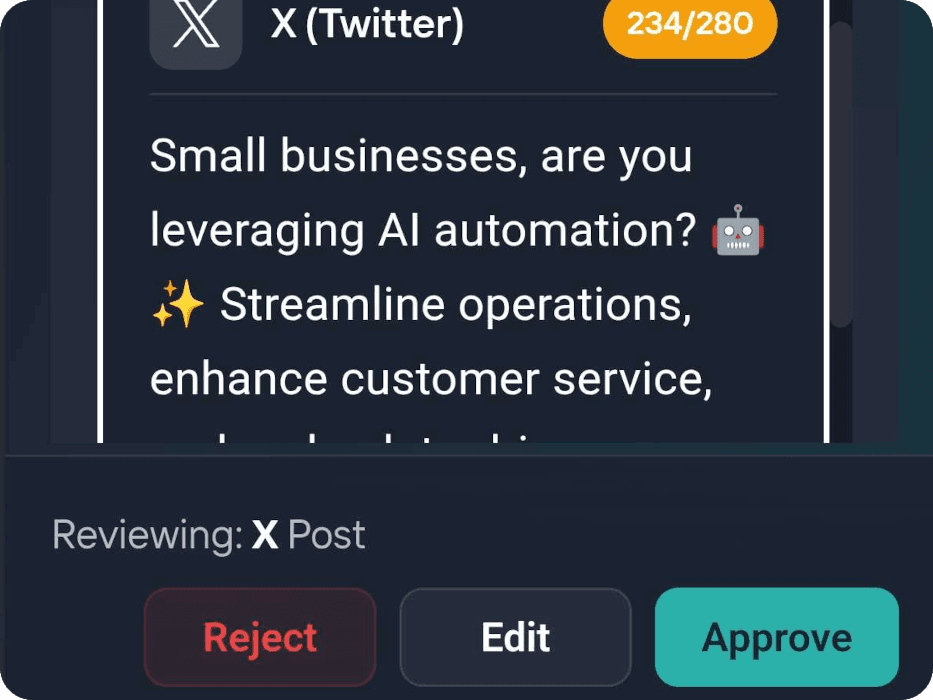
Theory is fine. Let me show you the real thing.
This is the social media workflow approval flow — the workflow that made us build Agentiff.AI in the first place.
Stage 1: Tell the in-app agent "Write a LinkedIn post about our feature launch"
Stage 2: The agent calls the social media Temporal workflow. The workflow generates platform-optimised content for LinkedIn, X, and Facebook — correct character limits, hashtag strategies, tone for each.
Stage 3: Workflow pauses. Push notification hits your phone.
Stage 4: Open Agentiff.AI on mobile. See each post with real-time preview. Chat with the agent to refine any post — edit copy, adjust tone, regenerate. The CopilotKit interface makes it reactive, not static.
Stage 5: Only after you approve does anything publish. Posts schedule through Postiz.
Stage 6: Full audit trail — what was generated, what you changed, what the agent refined, when you approved.
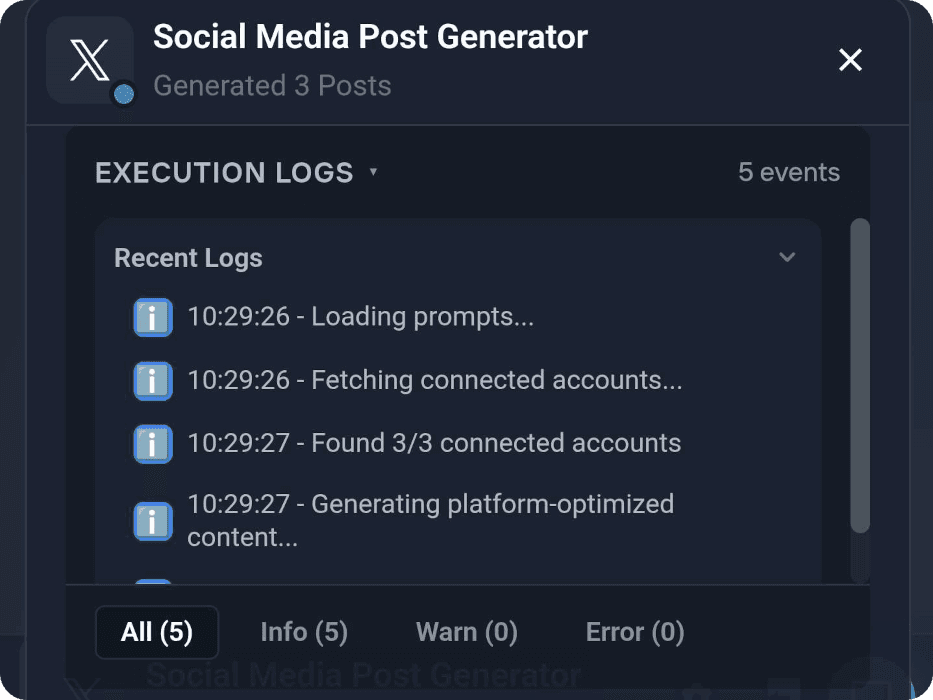
The Temporal workflow does the heavy lifting. The agent gives you a conversational interface to control it. Nothing goes live without your human-in-the-loop approval.
That's what "automations with oversight" means in practice.
Beyond Workflow Security: The Ripple Effect
Locking down your workflow automation doesn't just stop breaches. It changes how everything else works.
→ Fewer mystery failures. Temporal's durability means workflows survive restarts, network blips, and infrastructure hiccups. No more 3am crashes from fragile webhook chains.
→ You catch problems before clients do. Live workflow monitoring on your phone. Structured logs - timestamped, colour-coded by severity, filterable. Every request traced from trigger to completion. Real audit trail software built into the experience.
→ You scale without compounding risk. New client workflow, new integration, new AI agent - each one runs in Temporal, not in your n8n runtime. Growth doesn't widen your attack surface.
→ You can prove it to anyone who asks. Full audit trail. Every human decision logged. When compliance comes knocking, you've got the answer - on your phone.
The Agentiff.AI Manifesto
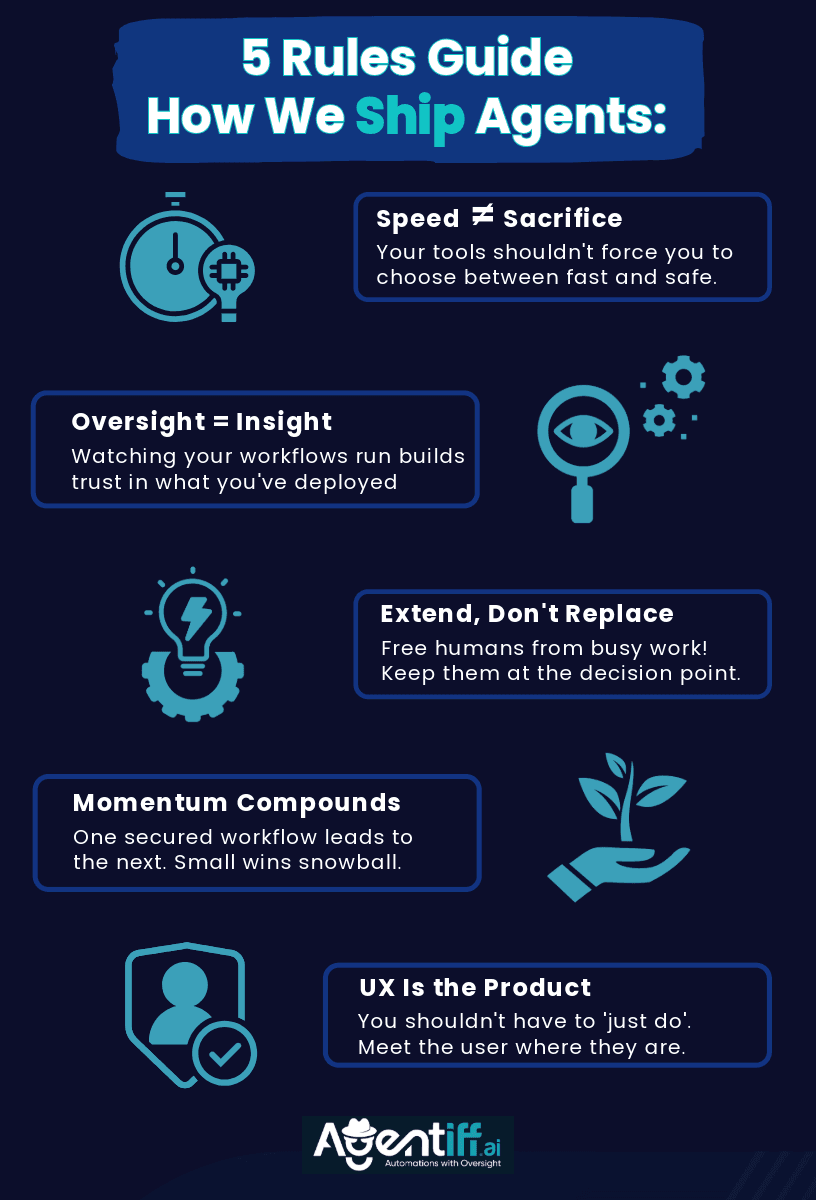
1. Speed should never cost you safety. Efficiency and security aren't trade-offs. If your tools force you to choose, your tools are broken.
2. Oversight is insight. Insight builds confidence. Watching your workflows run isn't micromanagement. It's how you learn what works, catch what doesn't, and trust what you've built.
3. Automations extend humans. They don't replace them. We're not here to remove you from the loop. We're here to free you from the busy work so you focus on the decisions that matter.
4. Small, tested wins beat big, untested overhauls. You don't need to rip out your stack to be more secure. Lock down one workflow. See the difference. Do the next one. Momentum compounds.
5. If the UX is an afterthought, the product is too. You shouldn't need a desktop, a terminal, and three browser tabs to check if your workflows are running. The interface meets you where you are — which is usually not at your desk.
Where We Are Right Now
Agentiff.AI is in alpha. Available on iOS (TestFlight) and Android (Firebase App Distribution).
I'm not going to tell you we're "enterprise-ready." We're not. Yet.
What we are is a small team that studied 342 real conversations from the n8n community, mapped the pain points, and built something that addresses the ones that keep people up at night.
We didn't cut corners on the foundation because the foundation is the whole point.
Social Media Post Generator/Scheduler (with human-in-the-loop workflow approval), Reddit crawler/GEO helper, Gmail Invoice Reporter, Social media trend detector
What's coming:
→ Fully-sovereign credential management (iOS Keychain / Android Keystore with biometric gating)
→ Runtime token injection and API key rotation for Modality 1
→ GPT-5 and Anthropic thinking models powering the in-app agent
→ Expanded workflow bundles for CRM, finance, and project management
→ Team-based workflow approval flows and shared oversight dashboards
→ Desktop app (our chosen framework makes this straightforward - planned for later this year)
Try It Free
You get approximately 10 image generations or 100 text generations — enough to run the social media workflow end to end and see what human-in-the-loop automation actually feels like.
We're collecting feedback, hardening security, and building toward beta (planned for March). Once we've got sufficient workflows, feedback, and security hardening done, we'll move to paid tiers with token-based pricing.
Right now, the goal is simple: try it, break it, tell us what's missing.